Auditioning My Mother: The Casting Exercise That Finally Unstuck My Memoir
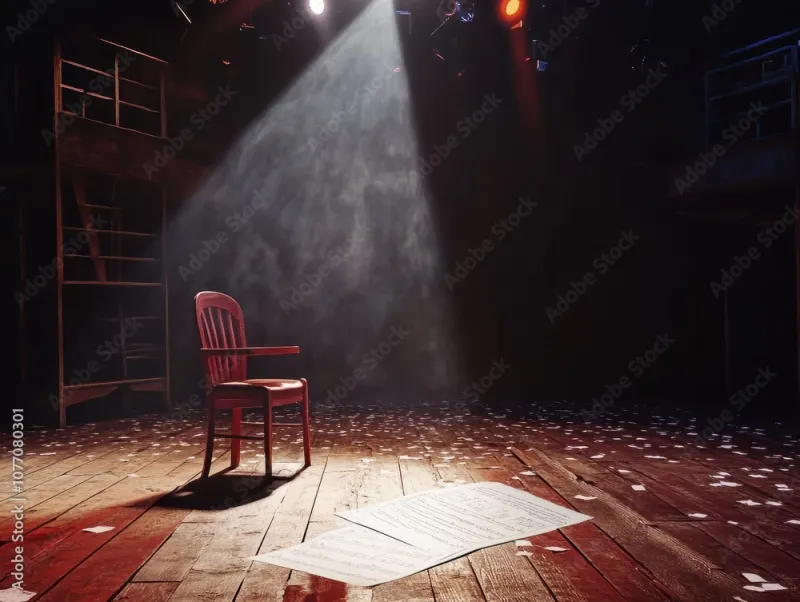
Photo: empty theater audition room with single chair and stage lights, via as2.ftcdn.net
The essay has been open in a document called "mom_essay_TRUE_FINAL" since roughly the second year of the pandemic. Two years of drafts. Two years of my mother existing on the page as, let's be honest, a slightly hostile voicemail with a cardigan.
Then last month, procrastinating in the way that only writers and people avoiding the gym can procrastinate, I did something strange. I imagined I was a casting director. Not writing the essay — casting it. And the whole thing cracked open.
The Game I Played Instead of Writing
Here's how it worked. I pretended a studio handed me a budget and asked me to adapt my own life into a limited series. My job wasn't to write it. My job was to fill the roles.
My mother first. I closed my eyes and thought: who could actually play her? Not who resembles her — who could hold her. Someone with warmth that reads as sharpness until you look again. Someone who could deliver a guilt trip as a genuine question and make the audience unsure whether it was one. The moment I imagined an actress doing that, I realized something uncomfortable: my draft had never given her a single moment of ambiguity. She was one note. A flat, scolding note, played on an instrument that in real life is a full orchestra.
I did the same for my dad. In my draft he was basically furniture — the quiet one, the guy reading in the other room. But when I thought about casting him, I needed an actor who could do stillness that communicates. An actor whose silence in a scene would make you lean in. My draft had no silences worth leaning into. That's not a character problem. That's a writing problem. Mine.
Then the hardest role: me. Twenty-eight-year-old me, the narrator of this whole mess. I imagined auditioning actresses for the part, and every single imaginary one asked the same question in the audition room: "What's her flaw? What does she get wrong in this story?"
Reader, in my draft, the narrator was right about everything.
You Can't Hand an Actor a Caricature
This is the thing nobody tells you about memoir and personal essay: you are the casting director, the writer, and the only witness. There's no actor to bail you out. If you write your uncle as a punchline, that punchline is what the reader gets — no performance to complicate it, no eyes welling up in the third act to redeem him.
Real actors talk about playing the contradiction. The villain who loves his dog. The saint who's petty about parking. When I imagined real performers stepping into my family members, every caricature collapsed instantly, because contradiction is the job. An actress cannot build a performance out of "overprotective mother." She needs the mother who memorized my college ID number but never once said she was proud of me — and who showed up at my apartment with a pressure cooker anyway.
The casting exercise is basically a lie detector for flat writing. If you can't imagine an actor making a person three-dimensional from what you wrote, you haven't written a person. You've written a position.
The Villain Audit
The exercise also forced a reckoning I'd been dodging. Every family memoir has a soft villain — the relative whose behavior the whole essay quietly orbits around. Mine was my grandmother, who said something at a wedding in 2011 that I have been marinating in for over a decade.
When I cast her, I couldn't find the actress. I kept imagining performers and every one of them felt wrong, and I finally understood why: I had never written her as a whole human. I'd written the wound she gave me and dressed it up as her. There was no role to cast because there was no character — just a scar with a name attached.
That's the difference between memory and storytelling. Memory is only what happened to you. A character is what happened, plus everything they were carrying that you never saw. The casting call made the gap between those two things visible for the first time.
What Changed in the Draft
Three concrete things, for anyone who wants to steal this exercise:
First, I gave my mother a scene where she's funny. Not funny to — genuinely funny, the person who made my cousins cry laughing at Thanksgiving. My draft had deleted her humor because it didn't serve my argument. That's not memoir. That's propaganda.
Second, I wrote my father a silence that means something. One paragraph where he doesn't speak and the reader understands exactly what he's saying anyway. It took four sentences and it did more than the twenty pages of explanation around it.
Third, and this is the big one: I let the narrator be wrong on the page. Not performatively wrong, not "oh I'm so flawed" wrong — actually wrong, in a way that costs her something. The imaginary audition room taught me that nobody wants to watch a protagonist who's already figured it out. We watch people mid-error.
Try It on Your Own Stuck Draft
If you've got a personal essay that's been flatlining, don't revise it. Cast it. Walk through it like a director walking into an audition room, and ask for each real person in your story: could a skilled actor do something interesting with what I've given them?
If the answer is no, the problem was never your family. The problem was the version of them you filed away for convenience. The good news — the genuinely great news — is that unlike a real casting director, you don't have to work with what's on the tape. You can go back and write the person you actually knew.
My essay isn't done. But for the first time in two years, my mother is someone I'd actually want to watch on screen. And weirdly, so is the narrator.