Sixty Seconds of Theme Song Taught Me More About Voice Than a Decade of Workshops
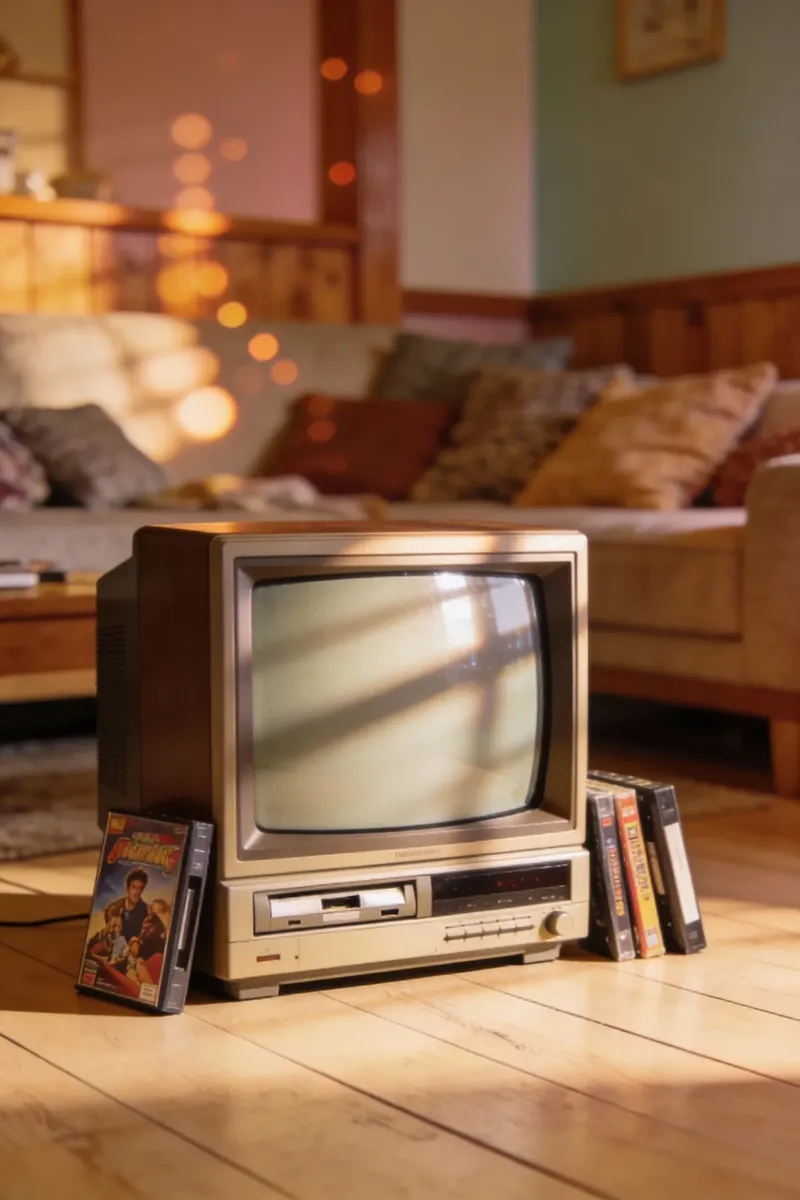
Photo: vhs tape paused on television screen retro living room, via media.bambrise.com
There's a version of this article where I tell you I did this for science. I didn't. I did it because my dad was visiting, I'd already exhausted my podcast queue, and the opening of Freaks and Geeks — which I have watched roughly four hundred times since college — was just sitting there, ninety seconds long, daring me.
So I opened my video player, slowed it down, and went frame by frame. Not because I thought I'd find anything. Because it felt like the kind of nerdy, useless thing a Sunday afternoon is for.
Reader, I found something.
Second 0 through 12: The Establishing Shot of a Worldview
The first thing that struck me, moving at quarter speed, is how much the sequence decides for you before a single line of dialogue plays. The lighting choices. The era-specific clutter — the gym uniforms, the rotary phones, the half-lockers. Nothing in those frames is neutral. Every object is doing a tiny bit of argumentation: this is a world where the details matter, where being fifteen is a full-time job.
That's when I paused on a shot of the hallway and had a genuinely uncomfortable thought: every piece of writing I've ever produced has a hallway shot, too.
The opening image of my essays. The detail I choose to lead with. The thing I put first because, apparently, I believe it defines everything after it. I went back and reread three of my own pieces with this lens, and yes — I always open on a person's hands, or an object mid-use. Always. I never noticed until a fictional high school hallway forced me to.
Second 34: The Frame I'd Been Skipping
Around the midpoint, there's a moment I'd mentally fast-forwarded through on every previous rewatch. At full speed it's nothing. Frame by frame, it's the emotional center of the whole sequence — a small, unglamorous beat that the show quietly insists on including even though nobody asked for it.
And that's the thing about voice, I think. Voice isn't your jokes or your metaphors. Voice is the beat you refuse to cut even though the pacing says you should. It's the thirty-fourth second. The aside that doesn't advance anything. The parenthetical your editor circles.
I keep an old notebook from a workshop years ago where an instructor wrote, in red pen, "cut this whole paragraph." I did not cut it. That paragraph was my thirty-fourth second. I just didn't have the vocabulary for it yet.
What Gets Buried in the Theme Song
Here's the exercise I gave myself afterward, and I'd recommend it to anyone who makes things: pretend your body of work has an opening credits sequence. Sixty seconds. What's in it?
Mine, if I'm honest: chai going cold next to a laptop. A group chat lighting up at 1 a.m. A rejection letter pinned somewhere visible. What's not in it — and this surprised me — is anything about success. No bylines, no milestones. I foreground the process and bury the outcome, every single time, without deciding to.
Which is useful information! If my creative credit sequence is all process, then when I catch myself writing about results, I can hear the theme song playing slightly off-key. Something's wrong with the episode.
The Case for Slowing Everything Down Once a Year
We consume openings at 1x speed, forever, and then wonder why our sense of our own work is equally blurry. The frame-by-frame thing isn't sustainable — nothing should be watched at quarter speed all the time — but once in a while, it recalibrates you. It's the difference between knowing a song and reading the sheet music.
My dad, for the record, thinks I've lost it. He watched me pause on a single frame for a full minute and asked if the Wi-Fi was broken.
"I'm working," I said.
He looked at the frozen image of a fictional hallway and, honestly, had every right to remain skeptical. But I stand by it. Sixty seconds, slowed all the way down, told me what I care about, what I hide, and what I refuse to cut.
That's more than most workshops ever gave me. And it cost me one lazy Sunday and a father's faith in my sanity.