Thirty Days, One Shelf, Zero Regrets: What Happened When a Stranger Picked Every Book I Read
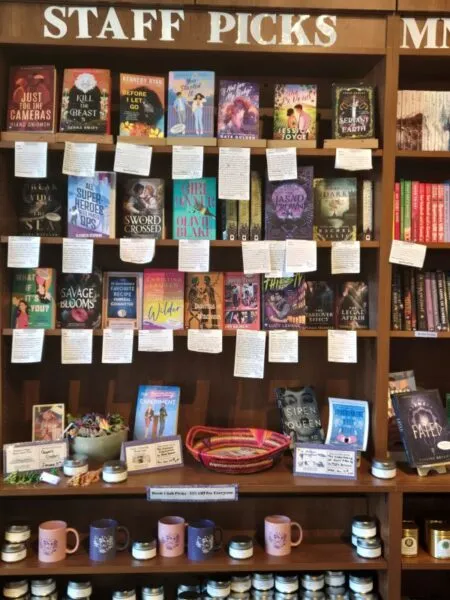
Photo: independent bookstore staff picks shelf handwritten recommendations, via publiclibrariesonline.org
The Rules I Made Up (and Mostly Followed)
Here's the experiment: for thirty days, every book I read had to come from the staff picks shelf at a single independent bookstore near me. Not staff picks across the internet. Not a general vibe of "books booksellers like." One shelf. One store. The handwritten cards, the laminated pull-quotes, the whole thing.
The rules were simple. If a book wasn't on the shelf, I couldn't read it. If I finished a book and nothing new had been added, I could reread or I could wait. If I hated a book, I still had to give it fifty pages, because that's roughly how long it takes for me to DNF something out of laziness rather than genuine dislike.
Why do this? Because I'd realized, somewhere around my fourth abandoned sample chapter and my ninth algorithmic "you might also like," that I hadn't been surprised by a book in over a year. Every recommendation I received came from a system that had already studied me. The algorithm knows I love quiet literary fiction with a hint of the uncanny. Great. But it also knows I'll click on it, so it feeds me twelve versions of the same book until they all blur together.
The staff picks shelf knows nothing about me. That's the whole appeal.
Week One: The Withdrawal Symptoms
The first thing I learned is that I am a control freak about books in a way I never noticed until I couldn't be. I stood in front of that shelf for a solid ten minutes on day one, trying to reverse-engineer the bookseller's taste from the cards. This one has a pull-quote from an author I like. Safe. This one has a pull-quote from an author I've never heard of. Dangerous.
I took the dangerous one. It was a debut novel about a family running a roadside attraction in the Southwest — not a setting, not a genre, not a tone I would have ever picked up. I read the first fifty pages out of obligation. Then I read the next two hundred out of something I hadn't felt in a long time, which was the specific pleasure of having no idea where a book was going.
That's the thing about total trust in a stranger's taste: you can't brace yourself. When I choose my own books, I've usually read three reviews, the acknowledgments, and the author's back catalog description before page one. I arrive pre-loaded. This time I arrived empty.
Week Two and Three: Curation Is a Lost Art, and It Has a Face
By the second week, I started recognizing the same initials on the recommendation cards. One bookseller in particular — let's call her K., because that's what the cards said — had taste that ran toward sprawling family sagas and books about food written with unbearable tenderness. Another, R., clearly loved anything strange and slim and sad.
I started to be able to read them the way you read a friend's face. "Okay, this is a K. pick. I know what I'm getting into." And that's when it hit me: curation isn't a filter. It's a relationship with taste that isn't yours. The algorithm flattens. A person's picks have a personality — inconsistencies, obsessions, blind spots, the novel they loved in a way they couldn't quite argue for.
The handwritten card is a lost art form, honestly. It's a tiny persuasive essay. "I don't usually go for books with talking animals, but." That "but" is doing more critical work than most reviews I've read this year.
What It Did to My Writing
I'm a writer, so of course the month leaked into my own work. Three things changed:
I got braver about structure. Reading books I never would have chosen meant absorbing structures I never would have studied. One of the K. picks was told almost entirely through a series of letters to a local newspaper, and I finished it furious that I'd never thought to try anything that lopsided.
I stopped writing for the version of me that's already reading me. When you know your reader too well, you start flattering them. The books that grabbed me hardest this month were the ones that assumed nothing about me at all.
I remembered that taste is a conversation, not a fortress. I used to treat my reading taste like a personality trait to defend. This month it was more like a guest room — people kept showing up with things, and some of it was great.
The Final Tally
Nine books. Four I loved, three I liked, one I finished out of sheer spite, and one — the roadside attraction novel — that I've now pressed into the hands of three different friends. Two of the nine were books I had actively decided against before the experiment started. One of those two is currently my favorite thing I've read all year.
Is this a sustainable lifestyle? No. I have a TBR pile that has filed a formal complaint. But I'm keeping a standing rule now: one book a month, minimum, from the shelf of a stranger. Because the opposite of the algorithm isn't rejecting curation. It's trusting a specific human being who loved a book so much they stood at a shelf and wrote about it by hand.
The staff picks shelf isn't a recommendation engine. It's a person, waiting patiently, holding out a book going trust me. I recommend letting them be right.