The Rejection Letter I Photocopies and Kept for a Decade
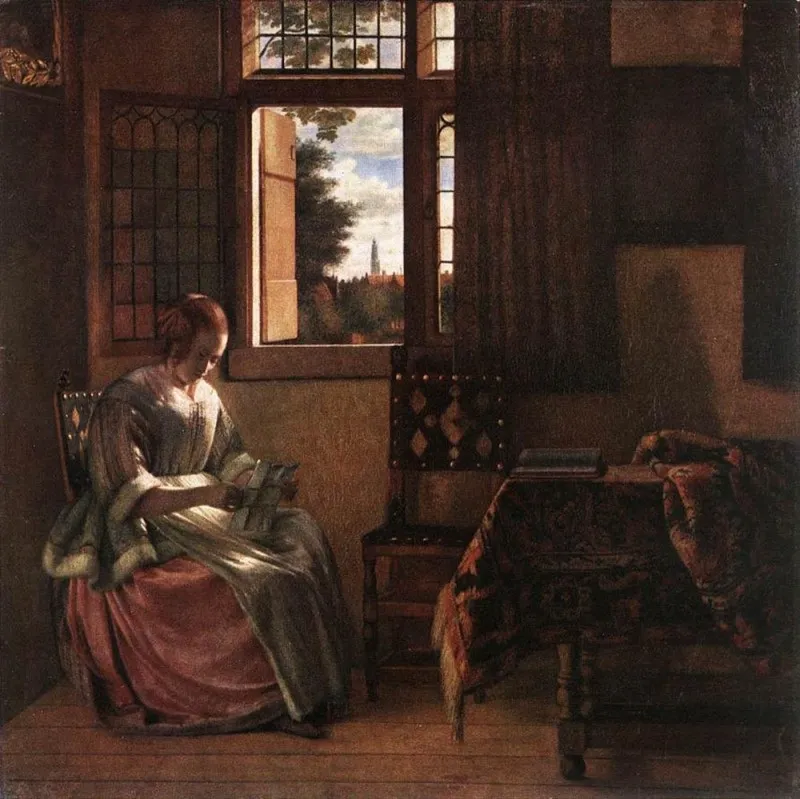
Photo: Pieter de Hooch, Public domain, via Wikimedia Commons
I still have the letter. It lives in a folder on my laptop called "OLD STUFF" — same folder as my tax documents from 2016 and a resume I haven't updated since grad school. I've never deleted it, and I've never sent a reply.
It arrived when I was twenty-six, attached to an email from an editor at a literary magazine I'd been dreaming about for years. I'd submitted a short story I genuinely believed was the best thing I'd ever written. And to be fair to twenty-six-year-old me, it probably was. That's not the same as it being good.
The letter ran four paragraphs. The first was polite. The other three were not.
The Part That Stung
She wrote that my protagonist "observed her own life rather than lived it." She wrote that my prose was "competent in the way a hotel room is competent." She said the ending resolved nothing because I'd been protecting my characters from consequence.
I read it standing in the kitchen of my shared apartment in Chicago, and I did what every writer does: I read it again. Then a third time. Then I closed the laptop and went for a walk around the block in February without a coat, which tells you something about how much it hurt.
The instinct, in that moment, was to dismiss her. She didn't get it. She was one editor. Plenty of magazines would love this story. That's the defensive reflex, and honestly, it kept me warm that night.
But here's the thing I couldn't shake: she was also right. Not about everything. But the protagonist thing — the observing-her-own-life thing — I recognized it the second I read it. I'd been writing characters at arm's length because writing them up close meant writing about things I hadn't figured out myself.
The Two Traps
Over the next few years, I swung between two failures of judgment, and I suspect most writers know both.
The first is total capitulation. For a while, I treated every piece of feedback like a command. Workshop partner says the opening is slow? Cut it. Friend says the ending feels sad? Happier ending, done by Friday. My writing got smooth, agreeable, and completely anonymous. It sounded like everyone who had ever commented on it. It stopped sounding like me.
The second trap is the fortress. After the capitulation phase exhausted me, I went the other direction. Every note became an attack. Every criticism was evidence that the reader "wasn't my audience." This is a very comfortable place to write from, and nothing good ever came out of my fortress period. The work got stiffer, and worse, I stopped being able to tell the difference between a legitimate note and a bad one, because I'd stopped listening to any of them.
Building the Filter
What finally worked wasn't a rule. It was a delay, plus one question.
The delay: I don't respond to feedback — not out loud, not in my head, not even in a notes app — for at least three days. This isn't stoicism. It's engineering. My first reaction is always ego, either the wounded kind or the defensive kind, and neither one has good taste.
The question, which I stole from a writing teacher in Iowa City and have never stopped using: "What is this note actually pointing at?" Not "is this note correct" — notes are almost never correct as written. But a reader who says "the ending felt rushed" is rarely asking for more pages. They're telling you the ending didn't earn its landing. A reader who says a character is "unlikable" might mean the character is flat, or might mean they're being asked to judge her when the story wants them to understand her. Those are opposite problems with the same symptom.
So now I translate. Every note gets converted from prescription to diagnosis. Then I decide, on my own time, whether the diagnosis is real.
What I Kept, What I Threw Out
From that letter, I kept the observation about the protagonist. It changed how I write — I still check for it in every draft, that arm's-length quality, characters watching themselves on closed-circuit TV. That single sentence has been worth more to me than two years of workshop.
I threw out the hotel room line. I know people mean it as a compliment to say a writer's prose is "clean," but there's a version of that critique that just means "not to my taste," and taste is not a note. It took me years to feel allowed to say that.
And the letter itself? I kept it, obviously. Not as a wound. As a reference point. Every time I get feedback that makes my chest go hot, I remember that the worst-feeling letter of my life contained the most useful sentence anyone ever wrote about my work. The heat and the value aren't opposites. Sometimes they arrive in the same envelope.
I never wrote back. Twenty-six-year-old me wanted to argue. Forty-something me wants to say thank you, even though she'd probably find that insufferable. Both of us are right.